
The Case of the Soul –
Re-Enchanting the World with an Old Idea
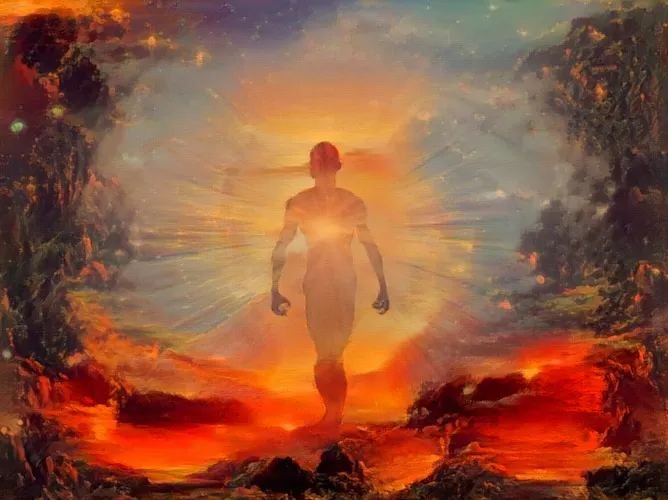
The idea of a “soul” runs through our language and culture. We talk about soulmates, soul-searching and those who have a “good soul”. In these contexts, “soul” refers to the essence of a person, a deep aspect of our identity beneath our surface personality.
The word soul derives from the Old High German word sêula, which was a translation by early Christian missionaries of the Greek word psyche. The ancient Greeks believed that the psyche was the source of life and consciousness. It was distinct from the body, and was thought to be immortal.
Most religions throughout history have held a similar view, that the soul is of a different nature to the body, inhabiting it like a genie in a bottle. Until the 19th century, almost every culture in human history took for granted that the essence of human identity was non-physical and would survive the death of the body.
Many religions envisage the afterlife as a paradise where the soul attains the fulfilment and happiness that eludes us during our physical lives. This may partly explain why the concept of the soul developed, or at least became prevalent.
From a modern perspective, these notions of the soul or an afterlife may seem naive. Surely we now know that there is no such thing as the soul or spirit, that human beings are mere “meat machines” – and that human identity or consciousness is just produced by neurological activity? Of course, this also means that there cannot be an afterlife, since human consciousness cannot outlive the brain that produces it.
Philosophically speaking, this modern worldview is known as materialism or physicalism – the belief that the universe is fundamentally physical, consisting of material particles and physical forces.
Although it may seem that we have some non-physical experiences – such as thoughts and feelings – these can be explained in physical terms. Thoughts may simply be the result of electrical signals produced by neurotransmitters. Feelings such as hope, love and sadness may simply be due to neurological activity.
The Problem of Consciousness

However, even if some pre-modern concepts of the soul were naive, there are serious problems with physicalism too. Physicalism cannot fully account for human experience, or fully explain the world we live in.
For example, despite decades of rigorous research, no one has any clear notion of which brain processes might be involved in consciousness. There are also many strange mismatches between brain activity and conscious experience, including cases of minimal brain activity – such as when people are in comas – where consciousness not only continues but sometimes becomes more intense than normal.
Another anomaly is the phenomenon of “terminal lucidity”, when dying people who suffer from severe psychiatric or neurological disorders – perhaps due to dementia, a stroke or meningitis — suddenly appear to regain full awareness, becoming lucid and alert.
One of the most striking anomalies is near-death experiences, when people with no signs of neurological or physiological activity later report powerful conscious experiences, even claiming to recall events they have heard or seen while apparently unconsciousness. There have been numerous attempts to explain these experiences. One possible idea is that in these states there may be an extremely low level of continuing neurological activity, which is not picked up. However, this would still leave the problem of how extremely minimal brain activity could generate experiences that more intense than normal consciousness.
With growing awareness of the difficulty of explaining consciousness in physical terms, more and more scientists and philosophers are considering alternative approaches. One viewpoint that has become more appealing to some philosophers (such as Susan Blackmore and Keith Frankish) is that consciousness may not actually exist, but is simply a cognitive illusion.
However, such anomalous experiences may also suggest that consciousness cannot be explained in purely physical terms. It might not be wholly dependent on, or produced by the brain – and could even derive from a non-physical source.
Another Worldview
Perhaps we need to reintroduce the concept of the soul, in a more nuanced way. We should be open to the possibility that the world contains non-physical elements and is even fundamentally non-physical. It may be that consciousness is a universal and fundamental quality. It doesn’t just exist in humans or other living beings – it is everywhere and in everything. My variant of this approach is called “panspiritism”.
Indeed, it is my belief that the human brain may not actually produce consciousness but transmits it. Like a radio, the brain “picks up” fundamental consciousness from the space around us and transmits it into us, so that we become individually conscious.
This could help to explain why we can sense each other’s feelings through empathy – because we share the same fundamental consciousness. It could also explain why consciousness can’t be precisely linked to neurological activity – because consciousness comes through the brain (rather than from it), from the space around us and ultimately from the universe itself.
In this interpretation, the soul (or consciousness) is not independent of the body. It interacts with the brain and body, to produce our mental activity and individual identity.
In these terms, it is not just human beings who possess a soul, as some Christians believe. If consciousness is fundamental, then the whole universe has a soul. Beyond that, all living things – even the simplest life forms – have a soul. In this scenario, our own soul derives from and is always part of the soul of the universe – just as a stream of water is always part of the fountain that it flows from.